


Yuna P.
Hi! My name is Yuna and I am a rising junior at Bellevue High School. This summer, I was an explorer at the Fred Hutch Explorer’s program, where we learned about a myriad of topics, ranging from laboratory tours to wet-lab procedures. I gained numerous fundamental laboratory skills, such as micropipetting, creating gels for electrophoresis, and extracting DNA. This program provided many immersive research experiences that extended far beyond what traditional classrooms could offer.

Allyson (left) and Yuna (right) waiting for the electrophoresis gel to cool.
Among these experiences, the CRISPR cas9 lab procedure stood out the most to me. This lab outlined an in vitro CRISPR-Cas9 digestion and gel electrophoresis analysis designed to test the targeting efficiency of specific guide RNAs on a PCR-amplified region of the BRCA1 gene. First, we combined PCR-grade water, Cas9 buffer, gRNA 4, and the Cas9 nuclease enzyme in a microtube to assemble an active RNP complex for binding target DNA. We repeated this step, using gRNA 5 instead of gRNA 4. Second, we added BRCA1 PCR product to each of the mixtures and incubated it in a heat block to prompt Cas9 to generate a double-strand break. Third, we added Proteinase K to each tube and incubated it at room temperature to release DNA fragments so they could move freely during electrophoresis. Fourth, we casted a 1.0% agarose gel using TAE buffer, placed it in a gel box with 0.5X TAE buffer, and loaded the wells with the samples. Last, we let the gel electrophoresis run and recorded the migration distances and results. This procedure is especially useful for ensuring that the chosen guide RNA will bind and cut the target sequence efficiently before investing time and resources into live cell transfection. It is vital in developing immunotherapies such as CAR T-cell therapies.

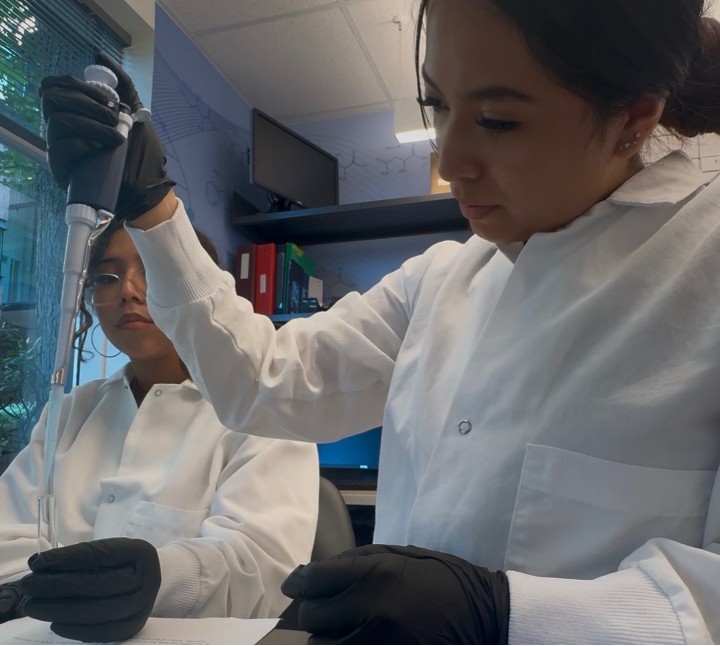
Yuna setting the volume on a micropipette.

Yuna recording the gel electrophoresis data.
Executing this lab work fascinated me because it made the power of gene editing real. By swapping out a sequence on the guide RNA, the Cas9 nuclease enzyme can be directed to an exact spot on the BRCA1 gene, creating a precise way to target specific genes. Seeing the predicted bands on the gel during electrophoresis proved the importance of the genetic manipulation in targeting specific DNA sequences accurately.
Besides the learning, I thoroughly enjoyed pranking Dr. G, making a candy salad, eating at our potluck, and playing Mafia! I created bonds I will never forget and made memories I will cherish forever.

Yari (left), Barbs (middle), and Yuna (right) walking to the lab!


Comments