


Emmett P.
The Fred Hutch Explorers Program was an amazing opportunity that made me aware of new paths in my life. The program had so many great experiences, like tours, lectures, and lab projects. One activity that I really enjoyed was the talk about liquid biopsies from Dr. Abizar Lakdawalla. Liquid biopsies are a way to screen for cancerous tumors that are cheaper and less dangerous than the previous method, tissue samples. When cells die, their DNA can be released into the bloodstream, and we can detect this cell-free DNA and identify mutations to determine if there is a tumor in the body. This eliminates the requirement of surgery, which can be dangerous and also expensive. Liquid biopsies also work outside of the bloodstream. For example, tumors in the brain may release DNA into cerebrospinal fluid, and it works the same as DNA in blood.

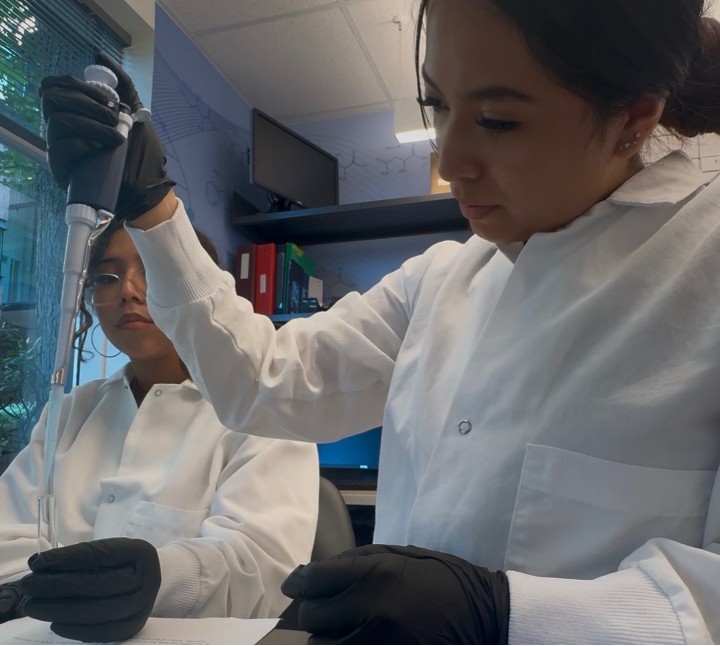
Me and my partner Victor in the lab, waiting for the results of our gel.
My favorite lab was the gel electrophoresis dye lab, because it was a fascinating introduction to an essential tool at Fred Hutch. The process of gel electrophoresis starts by first creating a block of gel made of agarose, which has tiny, microscopic pores that are used to “sort” molecules. There are two electrodes on opposite sides of the gel, one negative and one positive. We used this to test different kinds of dyes, and we had to identify two mystery dyes by how they traveled through the gel. Molecules move through the gel based on their electrical charge, size, and shape. The molecules are attracted to one of the electrodes based on whether they are positively or negatively charged. Less compact molecules can’t fit through the pores as easily as compact molecules, so they don’t go as far. This tool can be used for many things like verifying proper DNA replication or testing for mutations in genetic material.

A picture of our gel at the end of the gel electrophoresis process.
This internship really opened my eyes to how many different moving parts there are at Fred Hutch, and just how complex and interesting the study of cancer really is. Not only was this program about learning how things happen in the lab, it also showed us the whole process that goes into allowing Fred Hutch to perform amazing research. From writing grants and managing finances, there is a lot that many people don’t see behind all the breakthroughs in science. The Pathways Explorers Program showed me that there are many ways into this field, and everyone has their own unique ways of getting there. It also let me build a terrific community with researchers, scientists, and other interns that share my interests. Some of the best parts of my time at Fred Hutch were the times I spent learning and growing with my fellow interns. The time we spent playing Mafia, or plotting pranks for Dr. G really created a welcoming and kind community within our session that made the experience even more phenomenal. I want to give a huge thanks to everyone at Fred Hutch who helped organize the program, and especially Dr. G, who made this a completely unforgettable adventure for me.

A picture of the campus, which I took from the roof of the Thomas Building.


Comments